From
my recent diary
2026
Mainly, I use
the following materials since the end of October, 2018.
Telescope: D: 45.5cm f: 2037mm
Dobsomian (Newtonian reflector)
Eyepiece: and magnification:
Ethos 21 mm, apparent FOV 100 deg. 97x, actual FOV 1.0 deg.
or
Night Vison ACT PVS-14 Photonis
4G INTENS 1800 Auto gate P45 WP
Lavendura 63mm, apparent FOV 45 deg. with Paracorr, x37,
actual FOV 1.2 deg.
Sunday, April 26
I could spend only two nights, Wednesday 8th and Monday 16th, for
comet hunting due to cloudy and rainy weather. Nonetheless, I was lucky to
draw sketches for brightening comet, C/2025 R3 PanSTARRS, at both nights.
At predawn on Wednesday, though there were a few clouds at lower sky, the
sky was clear. Air temperature was 2°C and visibility was relatively good.
I observed C/2025 R2 with a tail that rose at an altitude of 5° above the
horizon at 3:40am local time using the 46 cm telescope. Just after the
observation, I started comet searching. When the comet rose at the
altitude of 13° I began to draw a sketch. The tail extended to due west,
and I noticed short, faint and broad tail in the northwest of the nucleus
of the comet using Lumicon Comet filter. Both tails are ion ones, and no
dust tail was visible.
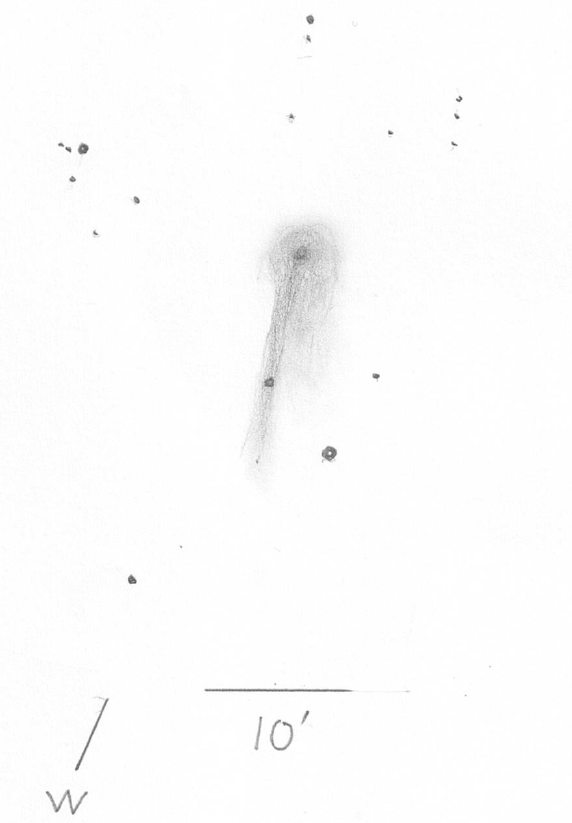
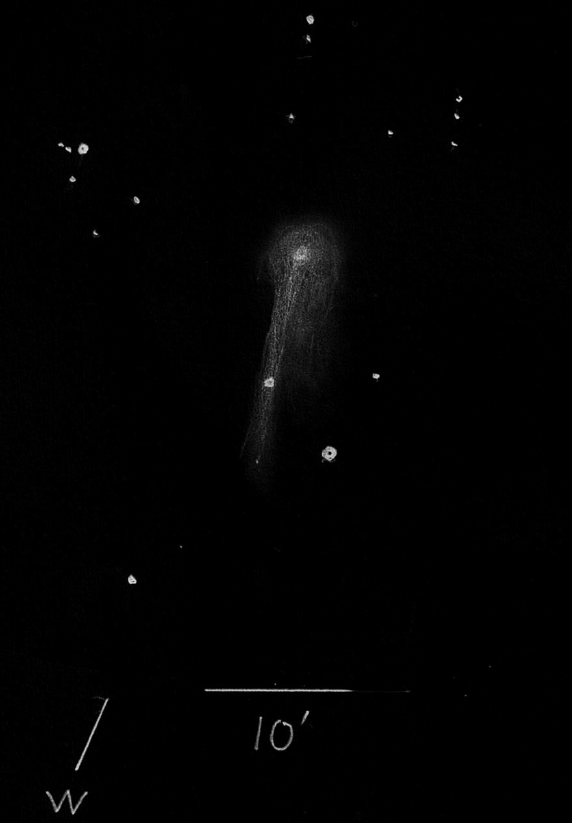
C/2025 R3 PanSTARRS.2026 April 08 4:28-4:36JST (07.811-7.817
UT)
mag. = 6, Dia = 5’, DC = 7, Tail 14’
46 cm, Ethos 21 mm、97x、Lumicon Comet filter.
|
|
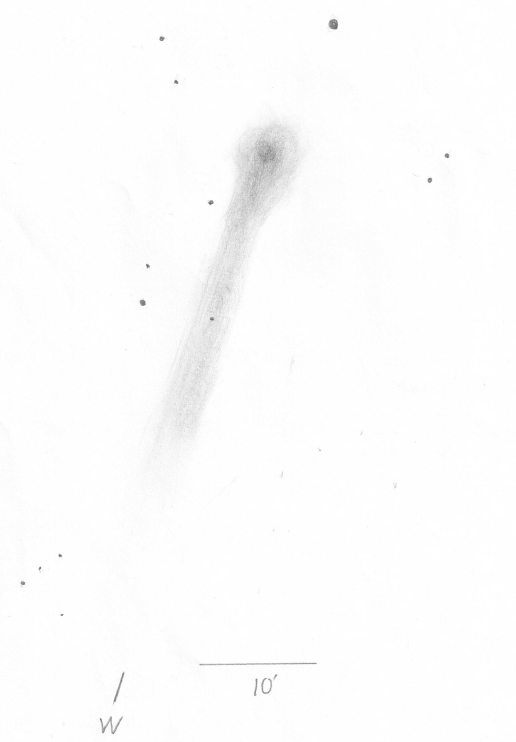
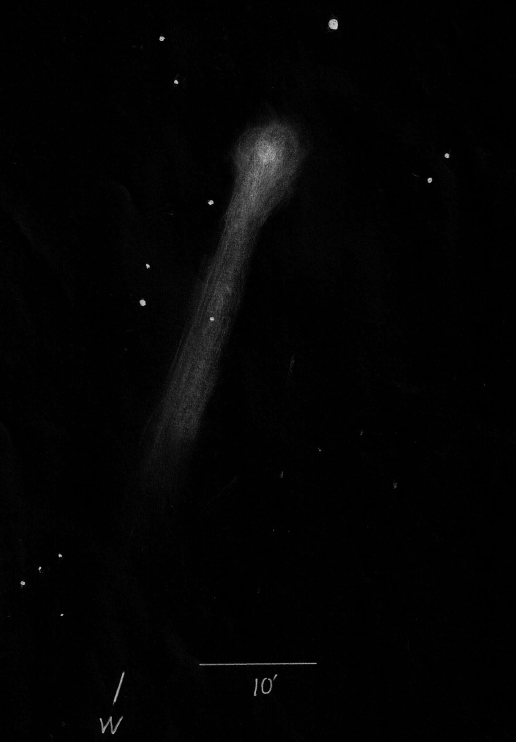
C/2025 R3 PanSTARRS.2026 April 16 4:28-4:36JST (07.811-7.817 UT)
46cm, Ethos 21 mm, 97x, mag. = 5, Dia = 6’, DC = 7, Tail 30’
At 2:24am local time, when I arrived at usual observation site, it was
cloudy. The forecast predicted the sky would become clear up as time went
on, and I decided to set up my telescope to wait for the weather to
improve. Just when I had completed setting up my telescope, the sky got
clear. However, there were clouds in the direction of C/2025 R3 was
located and I was unable to observe it. I conducted the hunting session in
the strong wind and unsettled condition. At 4:11am, M30, a globular
cluster in the constellation of Capricornus came into the FOV. At that
time, gaps in clouds appeared in the direction of the comet, and I aimed
my telescope.
Bright! The comet was much brighter than last time and magnificent with
longer tail. I was amazed by its transformation. It was 5th magnitude and
the straight tail extended precisely westward. Almost the same time when I
finished drawing the sketch, suddenly, clouds covered the entire sky. The
comet was hidden again. For the reason, I could not afford to apply the
filter and not confirmed if the comet was visible by naked eyes or a
binocular.
It has been nasty weather since then, and I was unable to observe C/2025
R3. I am looking forward to seeing what it will look like when it appears
in the evening sky in May.
Sunday, March 29
The total number of comet hunting sessions of this month was only
three, because I went on a business trip to attend a conference around the
period of new moon. I will write some impressive objects that I observed
on Saturday March 14 and Friday March 27.

Photo of NGC6818 taken by Hubble Space Telescope
Image credit: ESA/Hubble & NASA, Acknowledgment: Judy Schmidt
https://science.nasa.gov/missions/hubble/hubble-finds-a-little-gem/
At predawn on Saturday March 14, although the crescent moon was in the
constellation of Sagittarius, I dare to start the searching session with
M22 in the constellation. After I identified M24, M17, Moon, M26 and
NGC6712, NGC6818, a planetary nebula appeared in the FOV at 5:18am local
time, 12 min after the beginning of the twilight. The altitude of the
nebula was 24° above the horizon. I could not remember to have ever
identified the object, but I found the description on my website that I
did on March 10 in 2024 using Night Vision. SkySafari Pro 7, a digital
map, indicated that there is a barred irregular galaxy, NCG6822, 40’
south-southeast of NGC6818. I peered into Ethos 21 mm expecting that it
was impossible to observe the galaxy because the sky became brighter due
to twilight. When I strained my eyes a little, I could make out NGC6822,
though it was faint. I could observe the object in spite of moonlight
because of good transparency under the low air temperature of -4°C.
However, I think it was so dim that it was impossible to spot it during
the hunting session.
“Hidden Treasure” by Stephan James O’Meara reads the planetary nebula,
NGC6822, named Little Gem, is conspicuous because the famous galaxy,
NGC6822, is in the vicinity. I didn’t think this planetary nebula was
particularly remarkable, but NGC6822 certainly plays a significant role.
O’Meara stated in his book “The Carldwell Objects” that he observed
NGC6822 using 7x35 binocular and estimated the magnitude as 7.9. I think
it is challenging to do the same at my observation site, as the story is
applicable under very dark sky. A description on NGC6818 is also included
in “The Carldwell Objects” by O’Meara, and he wrote that the color of the
nebula was invisible. Contrary, in “Hidden Treasrue” he wrote the color
was pale ashen blue or steel gray. It is great pleasure to look for
description in the literature or to re-observe under the best sky
condition on each object identified during the comet hunting session.
On Friday March 27 I got out of my bed and went out just after 2am local
time, but the sky was covered with a thin layer of clouds. I thought that
the observation site might be also cloudy, and after much hesitation I
decided to head for the site. When I arrived at the site, there were some
clear patches but a lot of clouds as I afraid. Prior to the searching
session, I observed 24P Schaummasse. The comet was diffused with large
apparent diameter. I estimated magnitude of 11th, diameter of 5’ and DC =
1. Then, I trained my telescope at C/2025 R3 PanSTARRS. I heard the comet
became bright and is 8th magnitude, but I had not observed yet. I tried to
observe but could not because atmospheric light attenuation with the
altitude of only 2° at 4:01am local time. I tried again at 4:29am when the
altitude was 7°. Bright! Magnitude of 8, diameter 3’ and DC = 7. The comet
appearance was in stark contrast to that of 24P.

M23. The image is 60’ wide.
The Digitized Sky Survey copyright © 1994
I had no choice to change the search area here and there during the
session because clouds sometimes covered searching area. Under such
conditions, I was captivated by the open star cluster, M23. I must have
seen this open cluster dozens, no, hundreds of times by now, but it looked
more beautiful than ever. What made me so on earth? What is the difference
between being impressed and not when I see the same object? It is not the
difference in the sky condition but something in my mind is the cause of
the difference. It may be the difference in my body state. I have no idea
what kind of excitement await me next time. I think that motivates me to
continue comet hunting.
Wednesday, February 25
I comet hunted four times this month. Among them, I had a fulfilling
session under the wonderful sky condition on Saturday, February 21. Having
said so, upon the arrival I noticed higher degree of light pollution than
ever in the southeast, the direction of Nobeoka and Hyuga City with the
total population of some 170,000.

Location of the site in Takamori town, Kumamoto.
https://www.lightpollutionmap.info/
I observed 29P Schwassmann-Wachmann (magnitude 11.5, diameter 2’, DC=3)
and 24P Schaumasse (mag. 10, dia. 7’, DC=4)prior to the session. The
estimated magnitudes were not based on formal measurements but determined
by intuition. After enjoying the two comets, I observed additional
objects. Seeing was rather good and M13 showed a noble brilliance, while
each individual star in Omega Centauri flickered with scintillation as if
each is asserting something. M106 shines, surrounded by numerous galaxies.
I counted seven spiral arms in M101. After enjoying a 40 min observation,
I began to comet searching session at 4:30am local time, one hour before
the beginning of the twilight.
After the start of the session, I recognized that the light in the
southeast, which I believed to be light pollution, was actually the Milky
Way in the constellation of Sagittarius. Why could not I notice that in
spite of having the same experience every year? It stems from the fact
that steadily increasing light pollution year by year. I felt that the sky
in the southeast that is in the direction of Nobeoka, the west Kumamoto,
and the northeast Oita, all became brighter since 2018 when I moved to
Kumamoto and started to visit this observation site.

Variation in light pollution during 12 years at the site in Takamori,
Kumamoto Prefecture.
Distribution of light pollution across the entire sky in (a) 2012 and (b)
2024. South is down, east is left. (c) rate of annual change is
+2.62%/year.
https://www.lightpollutionmap.info/
Recent version up of Light Pollution Map boosted the function. That
reveals light pollution level at the observing site in Takamori, Kumamoto
Prefecture deteriorate as I felt, and the rate is 2.65%/year. The rate
around Ozu Town where I live is as high as 3.65%, and it had become worse
rapidly especially in 2022 and after (data are not shown). It coincides
with the rapid development that taken place since Taiwan Semiconductor
Manufacturing Company. Light pollution from Nobeoka and Oita City also
increase that made the entire sky brighter.

Light pollution at the observation site at Tokamachi, Niigata Prefecture
with the altitude of 963 m. Annual increase rate is quite small, +0.65%.
(a) Entire sky in 2024, (b) annual variation. https://www.lightpollutionmap.info/
Of all the locations where I conducted regular observation to date, the
plateau with the altitude of 963 m in Tokamachi City, Niigata, had the
lowest light polluted level. Although the site is inaccessible during
winter due to snow, I made two new “discoveries” during limited non-snowy
seasons. First, I saw the filament structure and the feature as if a crab
was walking moving the legs due to scintillation in M1, the Crab Nebula,
for the first time as I wrote in the
diary on October 24, 2015. Second, in the observation site I noticed
a planetary nebula, IC1295, which I had never observed as described in the diary on May 18, 2016. The annual
increase rate of the light pollution at the site is quite small, at 0.65%.
Until now, numerous comet hunters have given up to visual searching
because of light pollution, and have been forced to change to photographic
methods. The number of visual hunters will continue to decline due to
increase in light pollution globally. Even so, I intend to keep visual
hunting, because a chance of visual discovery remains.
Saturday, January 31
Although we usually have many days with clear sky from October to
December, there were fewer clear skies last year. However, in January I
conducted comet hunting 10 times thanks to sudden increase in clear skies.
Especially, I comet hunted six consecutive days at predawn from January 14
through 19. There were some more moonless starry nights other than the
days I conducted the hunting sessions, but I was to fatigue to search.
On Thursday, January 1, I observed three comets, 3I ATLAS, 29P
Schwassmann-Wachmann, and 24P Shaumasse. The transparency was poor on
Saturday, 17, which exacerbated light pollution, especially, emitted from
Nobeoka City, some 55 km southeast from the observation site. Even if it
were not for it, light pollution becomes worse in the past few years due
to rapid development in Kikuyo town and Ozu town, east of Kumamoto City,
because Tiwan Semiconductor Manufacturing Company (TSMC) has established.
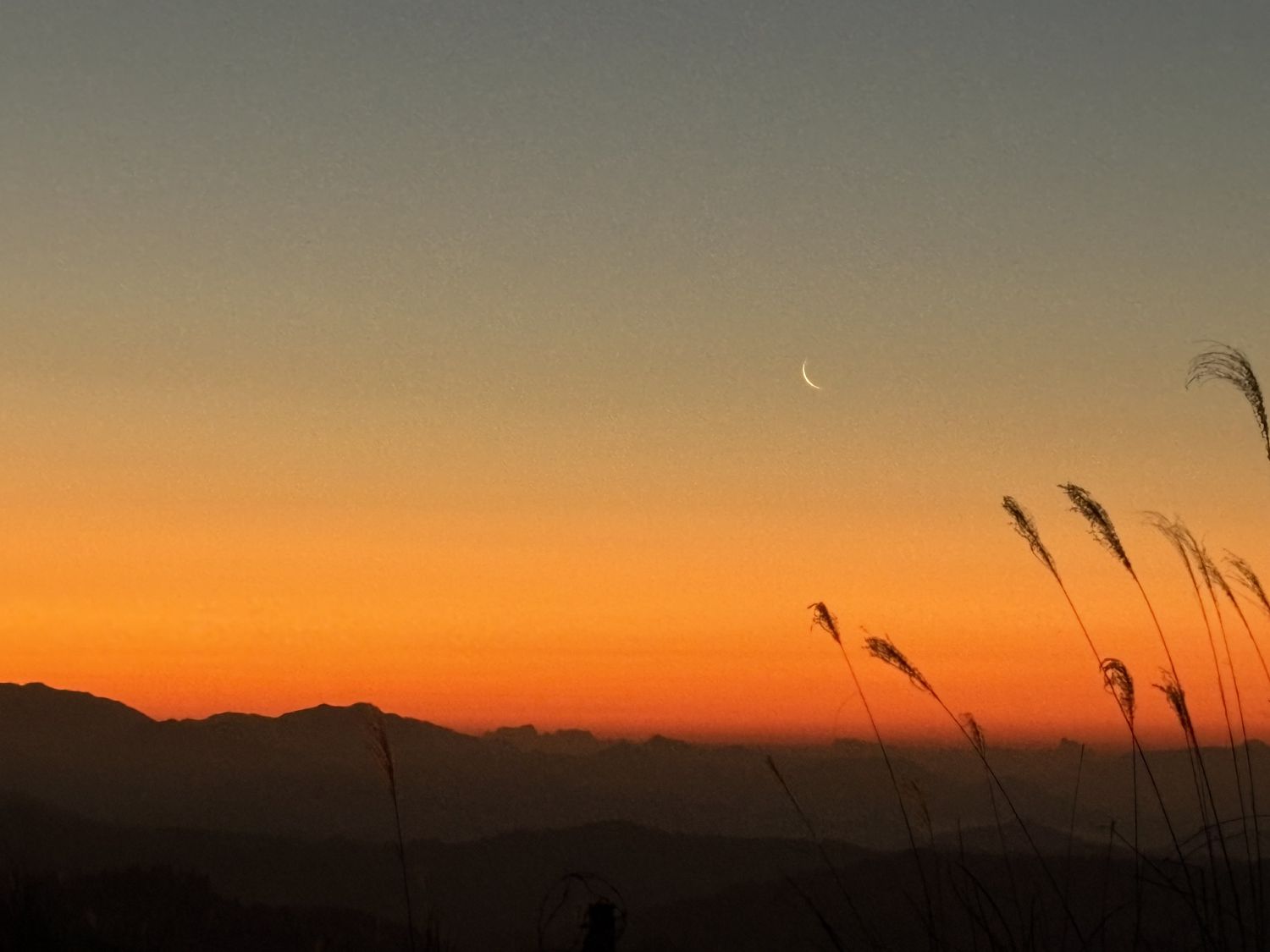
Moon rose during taking down my telescope on Saturday, January 17. The sky
was red due to yellow sand from the continent.
On a warm day air temperature was +5°C, while when cold wave came it was
as low as -9°C that was the same with the record low at the site.
Nonetheless, perceived temperature cannot be determined by the air
temperature alone. One feels colder at near 0°C with wind than at -9°C
(Monday, Jan. 26) with windless. On Monday, January 26 the amount of snow
was large. The depth was around 10 cm at the place where snowmelt has not
yet melted.

After completed the comet hunting session on Monday, Janudary 26. Beyond
remaining snow, the majestic mountain, Mt. Sobosan, came into view.
On Wednesday, January 28, I started comet hunting with M12, a globular
cluster in the constellation of Ophiuchus. After that, M10 and M14 came
into the FOV. The next deep sky object I identified was NGC6353! This
globular cluster with the magnitude of 9.3 is a memorable celestial object
identified just before the
discovery of C/2002 E2 Snyder-Murakami. At the time of discovery, I
captured another globular cluster, NGC6426, with the magnitude of 10.9,
but I overlooked it this session. Although the altitude above the horizon
for NGC6426 at the hunting session this time was about 26° that was
sufficiently high, I overlooked. The cause was poor transparency and light
pollution. If a new comet that had the same appearance and brightness with
C/2002 E2 had been in the area of searching, I could not have detected it.
The next object came into the FOV was NGC6712, a globular cluster in the
constellation of Scutum. I spotted a
possible new comet of 7th magnitude near this cluster on February 26
in 2004, while I was seeping the sky using 15x110 mm binocular. However,
it disappeared in the twilight before I confirmed the motion. I believe
the object must be a NEO. I reported the discovery, but the next day no
one in the world including me could observe the object.
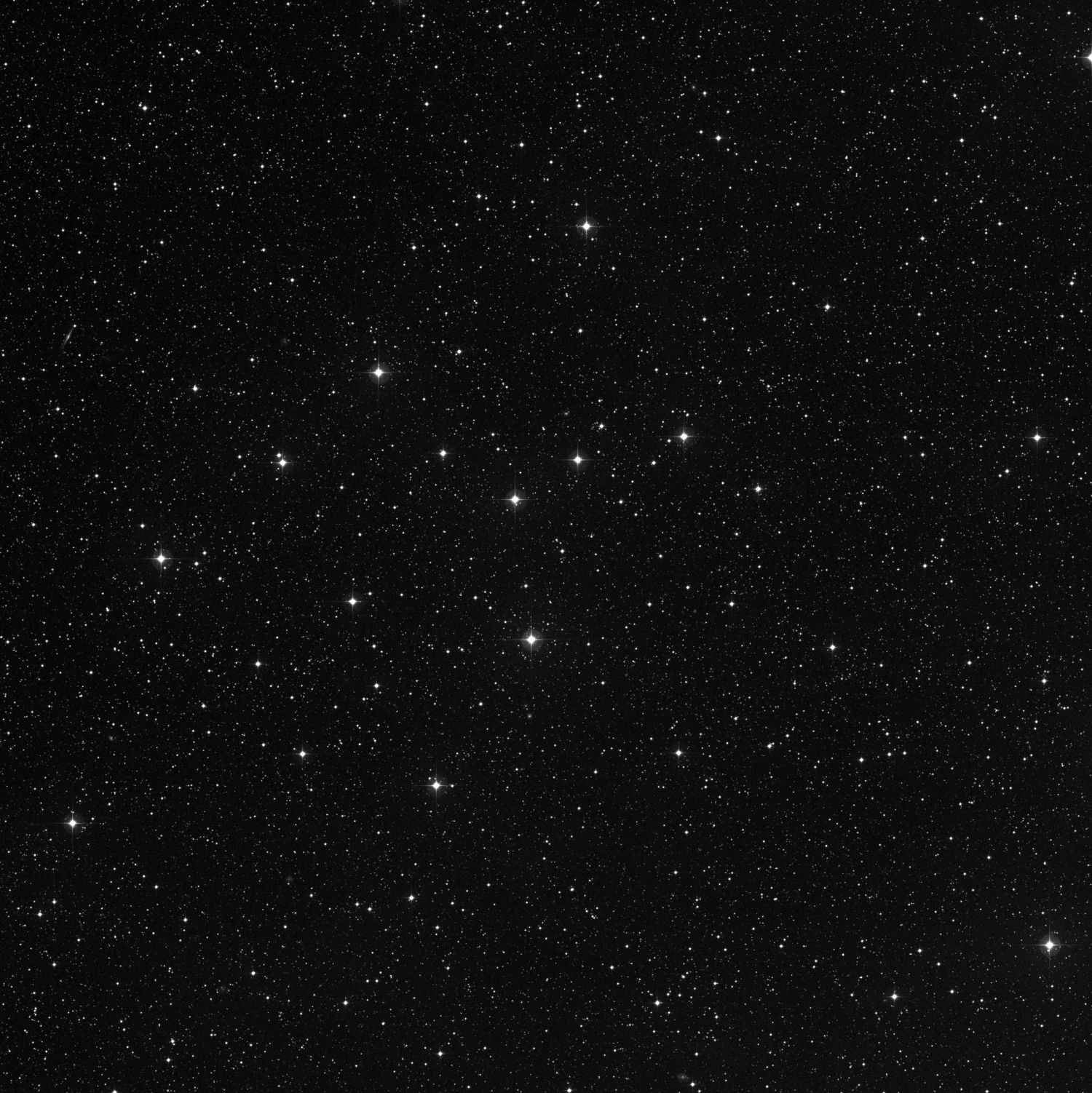
Open cluster, IC4665, in the constellation of Ophiuchus. The image is 60'
wide.
The Digitized Sky Survey copyright © 1994
After I observed such memorable celestial objects, a dazzling open cluster
that awaken senses popped up into the FOV. It was IC4655 that I saw many
times in the past, but I have never impressed like this time. It was as if
all stars in the cluster were cheering on the visual comet hunters. None
have succeeded visual comet discovery since Donald E. Mchholz achieved it
with C/2018 V1 Machholz–Fujikawa–Iwamoto. Visual hunters, make another
discovery!
Top of this page